Distributed Energy Resource Management System
The DERMS system is designed for regional power grids, focusing on integrated lifecycle management of new energy projects including distributed photovoltaics, distributed wind power, and energy storage systems. It covers core scenarios such as distributed power source registration, grid dynamic capacity assessment, access impact prediction, grid planning optimization, power quality simulation, comprehensive monitoring of source-grid-load-storage integration, and coordinated planning with energy storage data integration. The system provides end-to-end technical support for power grid operators, industrial park administrators, renewable energy developers, and regulatory authorities.
Get Solution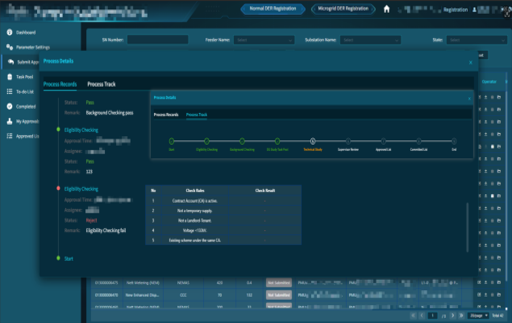
Core Features
Comprehensive New Energy Monitoring
Centralized display of distributed power sources, energy storage systems, and grid operation status, enabling visualization of operational data, statistical analysis, and anomaly detection.
Power Flow Calculation and Load Capacity Analysis
Based on real-time grid topology and load data, perform power flow calculations, voltage limit violations, and overload verification to dynamically assess the maximum capacity of distributed power sources.
Power Grid Planning
Based on regional power grid topology, load characteristics, and distributed energy output, scientifically evaluates access schemes to form a rational plan.
Technical Highlights
End-to-End Integrated Management
Breaks down data silos between distributed power sources, storage, and grid, enabling full-process collaboration from registration, analysis, simulation, monitoring to planning across the project lifecycle.
Exceptional Localization Adaptability
Strictly conforms to grid-related standards and energy regulatory requirements while remaining compatible with mainstream local energy storage and distributed power equipment communication protocols.
Intelligent Precision Empowerment
Integrates core technologies such as power flow calculation, multi-scenario simulation, and data modeling to achieve precise predictions of grid capacity, power quality, and renewable energy impact.
Target Users
Power grid companies and power distribution management units, park energy operation and management organizations, developers and construction units of new energy projects, and investment entities of energy storage and integrated energy.